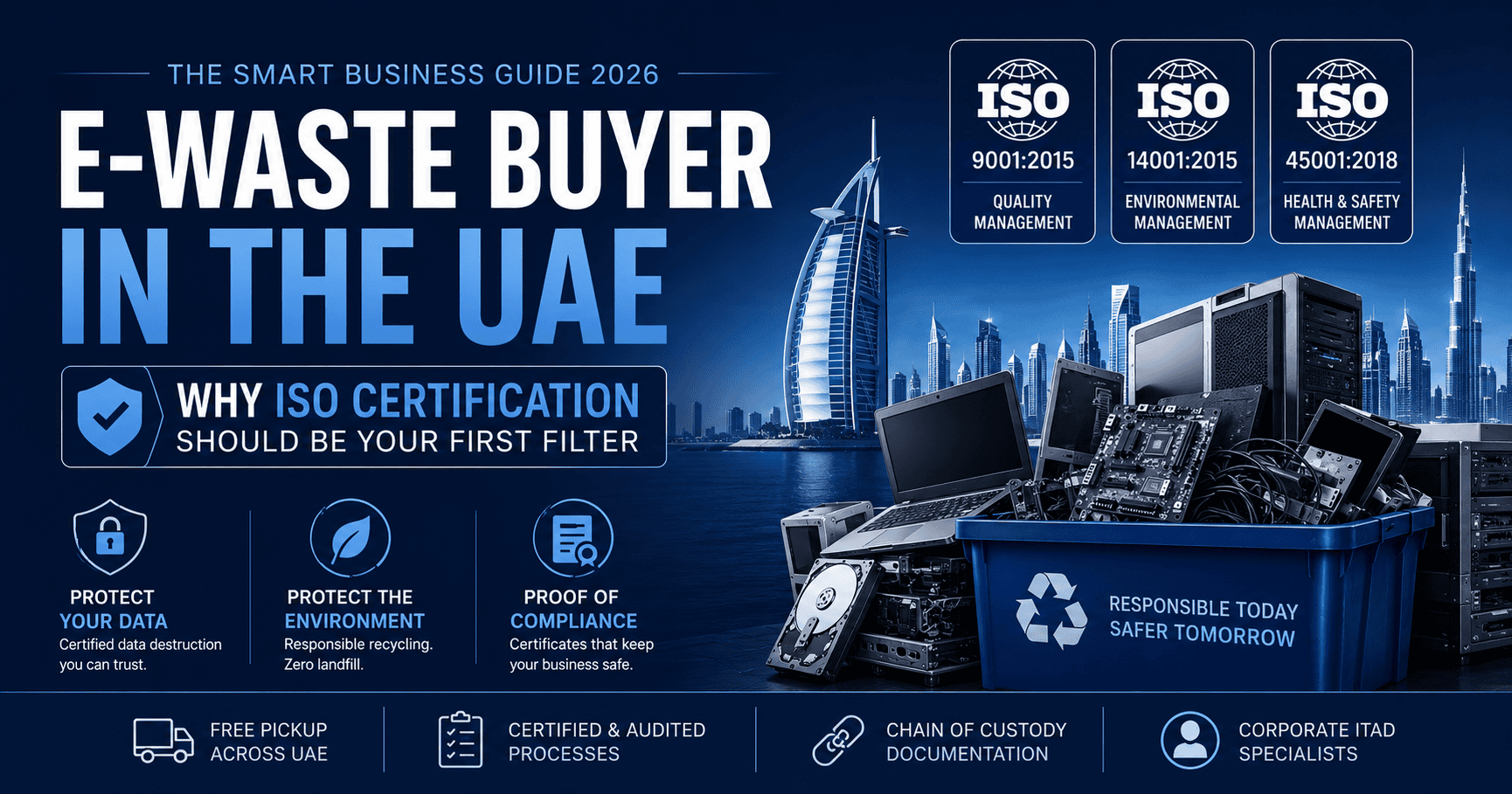
Every year, businesses across Dubai, Sharjah, Abu Dhabi, and Ajman replace laptops, servers, and networking gear on refresh cycles and every year, most of that hardware ends up handed to whichever “e-waste buyer” quotes the fastest cash offer. That’s a costly mistake. In the UAE, choosing an e-waste buyer isn’t just a housekeeping decision; it’s a compliance and data-security decision that carries real legal weight for the company handing over the equipment.
This guide breaks down what actually separates a reliable e-waste buyer in the UAE from a scrap dealer with a van, and why that difference matters more than the price per kilo.
The Hidden Risk Nobody Mentions in the Quote
When a company sells IT scrap old laptops, decommissioned servers, retired hard drives the responsibility for that data and that equipment doesn’t automatically end at handover. If the buyer isn’t a licensed, audited recycler, three risks follow the seller home:
- Data exposure. A drive that’s “wiped” with a factory reset is not the same as a drive that’s been sanitized to NIST SP 800-88 standard. Recoverable data on resold or dumped drives is one of the most common and most preventable — corporate data breaches in the region.
- Regulatory exposure. Under the UAE’s Personal Data Protection Law (PDPL), and the additional data-handling frameworks in free zones like DIFC and ADGM, the originating company can still be accountable for what happens to data-bearing assets after disposal — not just the recycler.
- Environmental liability. E-waste dumped or processed informally (rather than through a licensed facility) can trace back to the business that sold it, particularly for larger corporate clearances where paperwork gets requested later — during audits, insurance claims, or ESG reporting.
None of this shows up in a same-day cash quote. It shows up later, when someone asks for proof.
What “Certified” Actually Means — and Why It’s Rare
Plenty of e-waste buyers in Dubai advertise themselves as “responsible” or “eco-friendly.” Far fewer can produce third-party audited certification. Three certifications matter most when evaluating a buyer:
ISO 9001:2015 (Quality Management) confirms the buyer runs a documented, repeatable process — not an ad hoc pickup-and-resell operation.
ISO 14001:2015 (Environmental Management) confirms the buyer has an audited system for how materials are sorted, processed, and kept out of landfill or informal export channels.
ISO 45001:2018 (Occupational Health & Safety) matters more than people expect e-waste handling involves batteries, heavy equipment, and hazardous components, and a buyer without a safety management system is a liability risk on your own premises during pickup.
A genuinely certified buyer will hold certificates from a recognized certification body and should be able to produce them on request — not just display a badge in a website footer.
Questions to Ask Before You Hand Over a Single Laptop
If you’re clearing an office, a data center, or even a handful of retired workstations, ask any prospective buyer these questions before booking a pickup:
- Can you provide a Certificate of Data Destruction for drives, referencing a recognized standard (e.g., NIST SP 800-88)?
- Are you ISO 9001, 14001, and 45001 certified and can you share the certificates, not just claim them?
- Do you provide a Certificate of Recycling / Disposal that documents what happened to the equipment after pickup?
- Is the pickup free, and is there a written agreement covering liability during transport?
- Do you serve my emirate directly, or will my equipment be subcontracted to a third party?
A buyer that hesitates on any of these is telling you something.
Bulk Corporate Clearances Need a Different Process Than a Single Laptop
Selling one old laptop and clearing an entire office floor are not the same job. Bulk IT asset disposition (ITAD) for corporate clients typically needs:
- An on-site or pre-pickup inventory audit (asset tags, serial numbers) for internal finance and compliance records
- Chain-of-custody documentation from the moment equipment leaves your premises to final processing
- Options for on-site data destruction for organizations that can’t let data-bearing devices leave the building unsanitized
- A single point of contact who can coordinate pickups across multiple UAE locations, rather than separate vendors per emirate
Businesses that skip this and go with the lowest quote often find out too late that “we’ll recycle it responsibly” was a verbal promise with no paperwork behind it.
What to Look for in Your E-Waste Buyer
When you’re evaluating who picks up your retired IT assets, insist on documented data destruction and recycling certificates for every pickup — whether it’s a single decommissioned server or a full office clearance — so the paper trail exists before anyone asks for it, rather than a verbal promise after the trucks have left.
If your business needs to clear IT assets and wants the disposal handled by a buyer that can actually prove compliance, get in touch for a free assessment and pickup quote.
FAQ
Is selling e-waste to an uncertified buyer illegal in the UAE? It depends on the material and volume, but even where it isn’t outright illegal, the originating business can remain exposed on data protection and environmental grounds if the buyer mishandles the equipment. Certification is the practical way to transfer that risk properly.
Do I need a Certificate of Data Destruction even for old laptops with no sensitive data? Yes — “no sensitive data” is rarely verified until it’s too late. Browser-saved credentials, cached files, and email data routinely survive a standard factory reset.
Do you handle bulk pickups across multiple UAE emirates? Yes — coordinating pickups directly across the UAE rather than subcontracting per emirate keeps chain-of-custody consistent for multi-site corporate clients.




Leave a comment